by Bill Mann
The scare ads and op-ed pieces featuring Canadians telling us American how terrible their government health-care systems have arrived - predictably.
There's another, factual view - by those of us Americans who've lived in Canada and used their system.
My wife and I did for years, and we've been incensed by the lies we've heard back here in the U.S. about Canada's supposedly broken system.
It's not broken - and what's more, Canadians like and fiercely defend it.
Example: Our son was born at Montreal's Royal Victoria Hospital. My wife got excellent care. The total bill for three days in a semi-private room? $21.
My friend Art Finley is a West Virginia native who lives in Vancouver.
"I'm 82, and in excellent health," he told me this week. "It costs me all of $57 a month for health care, and it's excellent. I'm so tired of all the lies and bullshit I hear about the system up here in the U.S. media."
Finley, a well-known TV and radio host for years in San Francisco, adds,
"I now have 20/20 vision thanks to Canadian eye doctors. And I haven't had to wait for my surgeries, either."
A Canadian-born doctor wrote a hit piece for Wingnut Central (the Wall Street Journal op-ed page) this week David Gratzer claimed:
"Everyone in Canada is covered by a single payer -- the government. But Canadians wait for practically any procedure or diagnostic test or specialist consultation in the public system."
Vancouverite Finley: "That's sheer b.s."
I heard Gratzer say the same thing on Seattle radio station KIRO this week. Trouble is, it's nonsense.
We were always seen promptly by our doctors in Montreal, many of whom spoke both French and English.
Today, we live within sight of the Canadian border in Washington state, and still spend lots of time in Canada.
Five years ago, while we were on vacation in lovely Nova Scotia, the Canadian government released a long-awaited major report from a federal commission studying the Canadian single-payer system. We were listening to CBC Radio the day the big study came out.
The study's conclusion: While the system had flaws, none was so serious it couldn't be fixed.
Then the CBC opened the lines to callers across Canada.
Here it comes, I thought. The usual talk-show torrent of complaints and anger about the report's findings.
I wish Americans could have heard this revealing show.
For the next two hours, scores of Canadians called from across that vast country, from Newfoundland to British Columbia.
Not one said he or she would change the system. Every single one defended it vigorously.
The Greatest Canadian Ever
Further proof:
Not long ago, the CBC asked Canadians to nominate and then vote for The Greatest Canadian in history. Thousands responded.
The winner? Not Wayne Gretzky, as I expected (although the hockey great DID make the Top 10). Not even Alexander Graham Bell, another finalist.
The greatest Canadian ever?
Tommy Douglas.
Who? Tommy Douglas was a Canadian politician - and the father of Canadian universal health care.
Link
"This problem makes me remember the whole prescription drug fiasco from a few years back."
6.18.2009


Debunking Canadian Health Care Myths
As a Canadian living in the United States for the past 17 years, I am frequently asked by Americans and Canadians alike to declare one health care system as the better one.
Often I'll avoid answering, regardless of the questioner's nationality. To choose one or the other system usually translates into a heated discussion of each one's merits, pitfalls, and an intense recitation of commonly cited statistical comparisons of the two systems.
Because if the only way we compared the two systems was with statistics, there is a clear victor. It is becoming increasingly more difficult to dispute the fact that Canada spends less money on health care to get better outcomes.
Yet, the debate rages on. Indeed, it has reached a fever pitch since President Barack Obama took office, with Americans either dreading or hoping for the dawn of a single-payer health care system. Opponents of such a system cite Canada as the best example of what not to do, while proponents laud that very same Canadian system as the answer to all of America's health care problems. Frankly, both sides often get things wrong when trotting out Canada to further their respective arguments.
As America comes to grips with the reality that changes are desperately needed within its health care infrastructure, it might prove useful to first debunk some myths about the Canadian system.
Myth: Taxes in Canada are extremely high, mostly because of national health care.
In actuality, taxes are nearly equal on both sides of the border. Overall, Canada's taxes are slightly higher than those in the U.S. However, Canadians are afforded many benefits for their tax dollars, even beyond health care (e.g., tax credits, family allowance, cheaper higher education), so the end result is a wash. At the end of the day, the average after-tax income of Canadian workers is equal to about 82 percent of their gross pay. In the U.S., that average is 81.9 percent.
Myth: Canada's health care system is a cumbersome bureaucracy.
The U.S. has the most bureaucratic health care system in the world. More than 31 percent of every dollar spent on health care in the U.S. goes to paperwork, overhead, CEO salaries, profits, etc. The provincial single-payer system in Canada operates with just a 1 percent overhead. Think about it. It is not necessary to spend a huge amount of money to decide who gets care and who doesn't when everybody is covered.
Myth: The Canadian system is significantly more expensive than that of the U.S.
Ten percent of Canada's GDP is spent on health care for 100 percent of the population. The U.S. spends 17 percent of its GDP but 15 percent of its population has no coverage whatsoever and millions of others have inadequate coverage. In essence, the U.S. system is considerably more expensive than Canada's. Part of the reason for this is uninsured and underinsured people in the U.S. still get sick and eventually seek care. People who cannot afford care wait until advanced stages of an illness to see a doctor and then do so through emergency rooms, which cost considerably more than primary care services.
What the American taxpayer may not realize is that such care costs about $45 billion per year, and someone has to pay it. This is why insurance premiums increase every year for insured patients while co-pays and deductibles also rise rapidly.
Myth: Canada's government decides who gets health care and when they get it.
While HMOs and other private medical insurers in the U.S. do indeed make such decisions, the only people in Canada to do so are physicians. In Canada, the government has absolutely no say in who gets care or how they get it. Medical decisions are left entirely up to doctors, as they should be.
There are no requirements for pre-authorization whatsoever. If your family doctor says you need an MRI, you get one. In the U.S., if an insurance administrator says you are not getting an MRI, you don't get one no matter what your doctor thinks - unless, of course, you have the money to cover the cost.
Myth: There are long waits for care, which compromise access to care.
There are no waits for urgent or primary care in Canada. There are reasonable waits for most specialists' care, and much longer waits for elective surgery. Yes, there are those instances where a patient can wait up to a month for radiation therapy for breast cancer or prostate cancer, for example. However, the wait has nothing to do with money per se, but everything to do with the lack of radiation therapists. Despite such waits, however, it is noteworthy that Canada boasts lower incident and mortality rates than the U.S. for all cancers combined, according to the U.S. Cancer Statistics Working Group and the Canadian Cancer Society. Moreover, fewer Canadians (11.3 percent) than Americans (14.4 percent) admit unmet health care needs.
Myth: Canadians are paying out of pocket to come to the U.S. for medical care.
Most patients who come from Canada to the U.S. for health care are those whose costs are covered by the Canadian governments. If a Canadian goes outside of the country to get services that are deemed medically necessary, not experimental, and are not available at home for whatever reason (e.g., shortage or absence of high tech medical equipment; a longer wait for service than is medically prudent; or lack of physician expertise), the provincial government where you live fully funds your care. Those patients who do come to the U.S. for care and pay out of pocket are those who perceive their care to be more urgent than it likely is.
Myth: Canada is a socialized health care system in which the government runs hospitals and where doctors work for the government.
Princeton University health economist Uwe Reinhardt says single-payer systems are not "socialized medicine" but "social insurance" systems because doctors work in the private sector while their pay comes from a public source. Most physicians in Canada are self-employed. They are not employees of the government nor are they accountable to the government. Doctors are accountable to their patients only. More than 90 percent of physicians in Canada are paid on a fee-for-service basis. Claims are submitted to a single provincial health care plan for reimbursement, whereas in the U.S., claims are submitted to a multitude of insurance providers. Moreover, Canadian hospitals are controlled by private boards and/or regional health authorities rather than being part of or run by the government.
Myth: There aren't enough doctors in Canada.
From a purely statistical standpoint, there are enough physicians in Canada to meet the health care needs of its people. But most doctors practice in large urban areas, leaving rural areas with bona fide shortages. This situation is no different than that being experienced in the U.S. Simply training and employing more doctors is not likely to have any significant impact on this specific problem. Whatever issues there are with having an adequate number of doctors in any one geographical area, they have nothing to do with the single-payer system.
And these are just some of the myths about the Canadian health care system. While emulating the Canadian system will likely not fix U.S. health care, it probably isn't the big bad "socialist" bogeyman it has been made out to be.
It is not a perfect system, but it has its merits. For people like my 55-year-old Aunt Betty, who has been waiting for 14 months for knee-replacement surgery due to a long history of arthritis, it is the superior system. Her $35,000-plus surgery is finally scheduled for next month. She has been in pain, and her quality of life has been compromised. However, there is a light at the end of the tunnel. Aunt Betty - who lives on a fixed income and could never afford private health insurance, much less the cost of the surgery and requisite follow-up care - will soon sport a new, high-tech knee. Waiting 14 months for the procedure is easy when the alternative is living in pain for the rest of your life.
Link
Often I'll avoid answering, regardless of the questioner's nationality. To choose one or the other system usually translates into a heated discussion of each one's merits, pitfalls, and an intense recitation of commonly cited statistical comparisons of the two systems.
Because if the only way we compared the two systems was with statistics, there is a clear victor. It is becoming increasingly more difficult to dispute the fact that Canada spends less money on health care to get better outcomes.
Yet, the debate rages on. Indeed, it has reached a fever pitch since President Barack Obama took office, with Americans either dreading or hoping for the dawn of a single-payer health care system. Opponents of such a system cite Canada as the best example of what not to do, while proponents laud that very same Canadian system as the answer to all of America's health care problems. Frankly, both sides often get things wrong when trotting out Canada to further their respective arguments.
As America comes to grips with the reality that changes are desperately needed within its health care infrastructure, it might prove useful to first debunk some myths about the Canadian system.
Myth: Taxes in Canada are extremely high, mostly because of national health care.
In actuality, taxes are nearly equal on both sides of the border. Overall, Canada's taxes are slightly higher than those in the U.S. However, Canadians are afforded many benefits for their tax dollars, even beyond health care (e.g., tax credits, family allowance, cheaper higher education), so the end result is a wash. At the end of the day, the average after-tax income of Canadian workers is equal to about 82 percent of their gross pay. In the U.S., that average is 81.9 percent.
Myth: Canada's health care system is a cumbersome bureaucracy.
The U.S. has the most bureaucratic health care system in the world. More than 31 percent of every dollar spent on health care in the U.S. goes to paperwork, overhead, CEO salaries, profits, etc. The provincial single-payer system in Canada operates with just a 1 percent overhead. Think about it. It is not necessary to spend a huge amount of money to decide who gets care and who doesn't when everybody is covered.
Myth: The Canadian system is significantly more expensive than that of the U.S.
Ten percent of Canada's GDP is spent on health care for 100 percent of the population. The U.S. spends 17 percent of its GDP but 15 percent of its population has no coverage whatsoever and millions of others have inadequate coverage. In essence, the U.S. system is considerably more expensive than Canada's. Part of the reason for this is uninsured and underinsured people in the U.S. still get sick and eventually seek care. People who cannot afford care wait until advanced stages of an illness to see a doctor and then do so through emergency rooms, which cost considerably more than primary care services.
What the American taxpayer may not realize is that such care costs about $45 billion per year, and someone has to pay it. This is why insurance premiums increase every year for insured patients while co-pays and deductibles also rise rapidly.
Myth: Canada's government decides who gets health care and when they get it.
While HMOs and other private medical insurers in the U.S. do indeed make such decisions, the only people in Canada to do so are physicians. In Canada, the government has absolutely no say in who gets care or how they get it. Medical decisions are left entirely up to doctors, as they should be.
There are no requirements for pre-authorization whatsoever. If your family doctor says you need an MRI, you get one. In the U.S., if an insurance administrator says you are not getting an MRI, you don't get one no matter what your doctor thinks - unless, of course, you have the money to cover the cost.
Myth: There are long waits for care, which compromise access to care.
There are no waits for urgent or primary care in Canada. There are reasonable waits for most specialists' care, and much longer waits for elective surgery. Yes, there are those instances where a patient can wait up to a month for radiation therapy for breast cancer or prostate cancer, for example. However, the wait has nothing to do with money per se, but everything to do with the lack of radiation therapists. Despite such waits, however, it is noteworthy that Canada boasts lower incident and mortality rates than the U.S. for all cancers combined, according to the U.S. Cancer Statistics Working Group and the Canadian Cancer Society. Moreover, fewer Canadians (11.3 percent) than Americans (14.4 percent) admit unmet health care needs.
Myth: Canadians are paying out of pocket to come to the U.S. for medical care.
Most patients who come from Canada to the U.S. for health care are those whose costs are covered by the Canadian governments. If a Canadian goes outside of the country to get services that are deemed medically necessary, not experimental, and are not available at home for whatever reason (e.g., shortage or absence of high tech medical equipment; a longer wait for service than is medically prudent; or lack of physician expertise), the provincial government where you live fully funds your care. Those patients who do come to the U.S. for care and pay out of pocket are those who perceive their care to be more urgent than it likely is.
Myth: Canada is a socialized health care system in which the government runs hospitals and where doctors work for the government.
Princeton University health economist Uwe Reinhardt says single-payer systems are not "socialized medicine" but "social insurance" systems because doctors work in the private sector while their pay comes from a public source. Most physicians in Canada are self-employed. They are not employees of the government nor are they accountable to the government. Doctors are accountable to their patients only. More than 90 percent of physicians in Canada are paid on a fee-for-service basis. Claims are submitted to a single provincial health care plan for reimbursement, whereas in the U.S., claims are submitted to a multitude of insurance providers. Moreover, Canadian hospitals are controlled by private boards and/or regional health authorities rather than being part of or run by the government.
Myth: There aren't enough doctors in Canada.
From a purely statistical standpoint, there are enough physicians in Canada to meet the health care needs of its people. But most doctors practice in large urban areas, leaving rural areas with bona fide shortages. This situation is no different than that being experienced in the U.S. Simply training and employing more doctors is not likely to have any significant impact on this specific problem. Whatever issues there are with having an adequate number of doctors in any one geographical area, they have nothing to do with the single-payer system.
And these are just some of the myths about the Canadian health care system. While emulating the Canadian system will likely not fix U.S. health care, it probably isn't the big bad "socialist" bogeyman it has been made out to be.
It is not a perfect system, but it has its merits. For people like my 55-year-old Aunt Betty, who has been waiting for 14 months for knee-replacement surgery due to a long history of arthritis, it is the superior system. Her $35,000-plus surgery is finally scheduled for next month. She has been in pain, and her quality of life has been compromised. However, there is a light at the end of the tunnel. Aunt Betty - who lives on a fixed income and could never afford private health insurance, much less the cost of the surgery and requisite follow-up care - will soon sport a new, high-tech knee. Waiting 14 months for the procedure is easy when the alternative is living in pain for the rest of your life.
Link
Mapping World War III: Soviet Global Invasion Routes

A fascinating collection of strategic conceptual maps taken from a 1987 Department of Defense study, which examined the expected land and sea invasion routes for the Soviet Union in her primary operational theaters. Collectively the maps represents a staggering vision of armed global conflict that would have far outstripped even the most ambitious imperial wars of the Achaemenids, the Mongols, the Romans and Nazi Germany combined.
Visually, the Cold War was in many ways typified by maps of this sort. And it might have been the last period (at least for our lifetimes), where interstate warfare could be anticipated and expressed in such grand and expansive geo-strategic terms. Even with their large armies, powerful economies and ambitious national characters, it’s hard to imagine a comparable vision for world war driven by the armies of the three likely predominant powers of the 21st century: China, India and the United States.
Link
6.15.2009
Pixar Short - "Partly Cloudy" - Full Version
Partly Cloudy is a short Pixar film, directed by Peter Sohn and produced by Kevin Reher. It is shown in theaters before Up.

6.12.2009
Boat launch - you are doing it wrong

"Clearly he needs to pull ahead further to get the boat off the trailer."
6.11.2009

Canada and Mexico vs the US: A Visual Comparison
So close, and yet so far.
Tied together as much by geographic proximity as by NAFTA, Canada, Mexico, and the US are dependent on each other for much of their economic well being.
Understanding the differences and similarities between these co-dependent economies can provide you with a compelling picture of how various factors play into a country’s economic status.
To paraphrase Alice in Wonderland, you might be wondering what the use of a chart without scale or numbers is. But before you decide that we’ve gone too far down the rabbit hole, consider that our infographic is designed to provide a sense of relativity and scale.
It’s an at-a-glance view of the most important economic dimensions of the US and its nearest neighbors. In order to help compare and contrast the economic differences, we have simplified the data from the CIA World Factbook.
Link
"Fascinating. It shows the three countries comparatively and how inter-related they are but clearly points out the strengths and weaknesses."
Tied together as much by geographic proximity as by NAFTA, Canada, Mexico, and the US are dependent on each other for much of their economic well being.
Understanding the differences and similarities between these co-dependent economies can provide you with a compelling picture of how various factors play into a country’s economic status.
To paraphrase Alice in Wonderland, you might be wondering what the use of a chart without scale or numbers is. But before you decide that we’ve gone too far down the rabbit hole, consider that our infographic is designed to provide a sense of relativity and scale.
It’s an at-a-glance view of the most important economic dimensions of the US and its nearest neighbors. In order to help compare and contrast the economic differences, we have simplified the data from the CIA World Factbook.
Link
"Fascinating. It shows the three countries comparatively and how inter-related they are but clearly points out the strengths and weaknesses."
6.10.2009
Nokia developing phone that recharges itself without mains electricity

Prototype harvests radiowaves from TV, radio and other mobiles
Standby mode is often accused of being the scourge of the planet, insidiously draining resources while offering little benefit other than a small red light and extra convenience for couch potatos. But now Nokia reckons a mobile phone that is always left in standby mode could be just what the environment needs.
A new prototype charging system from the company is able to power itself on nothing more than ambient radiowaves – the weak TV, radio and mobile phone signals that permanently surround us. The power harvested is small but it is almost enough to power a mobile in standby mode indefinitely without ever needing to plug it into the mains, according to Markku Rouvala, one of the researchers who developed the device at the Nokia Research Centre in Cambridge, UK.
This may sound too good to be true but Oyster cards used by London commuters perform a similar trick, powering themselves from radiowaves emitted by the reader devices as they are swiped. And similarly old crystal radio sets and more recently modern radio frequency identification (RFID) tags, increasingly used in shipping and as antitheft devices, are powered purely by radiowaves.
The difference with Nokia's prototype is that instead of harvesting tiny amounts of power (a few microwatts) from dedicated transmitters, Nokia claims it is able to scavenge relatively large amounts of power — around a thousand times as much — from signals coming from miles away. Individually the energy available in each of these signals is miniscule. But by harvesting radiowaves across a wide range of frequencies it all adds up, said Rouvala.
Such wireless transfer of energy was first demonstrated by Nikola Tesla in 1893, who was so taken with the idea he attempted to build an intercontinental transmission tower to send power wirelessly across the Atlantic. Nokia's device is somewhat less ambitious and is made possible thanks to a wide-band antenna and two very simple circuits. The antenna and the receiver circuit are designed to pick up a wide range of frequencies — from 500 megahertz to 10 gigahertz — and convert the electromagnetic waves into an electrical current, while the second circuit is designed to feed this current to the battery to recharge it.
The trick here is to ensure that these circuits use less power than is being received, said Rouvala. So far they have been able to harvest up to 5 milliwatts. Their short-term goal is to get in excess of 20 milliwatts, enough power to keep a phone in standby mode indefinitely without having to recharge it. But this would not be enough to actually use the phone to make or receive a call, he says. So ultimately the hope is to be able to get as much as 50 milliwatts which would be sufficient to slowly recharge the battery.
Steve Beeby, an expert in harvesting ambient energy at the University of Southampton, said it would be a remarkable achievement. . "Radio frequency power falls off exponentially with distance," he says. Earlier this year researchers at Intel and the University of Washington, in Seattle, showed that they could power a small sensor using a TV signal 4.1 kilometres away.
Wireless charging is not intended as a sole energy source, but rather to be used in conjunction with other energy harvesting technologies, such as handset casings embedded with solar cell materials. According to Technology Review magazine, the phone could be on the market in three to five years.
Link
Monster Jellyfish Taking Over The Oceans
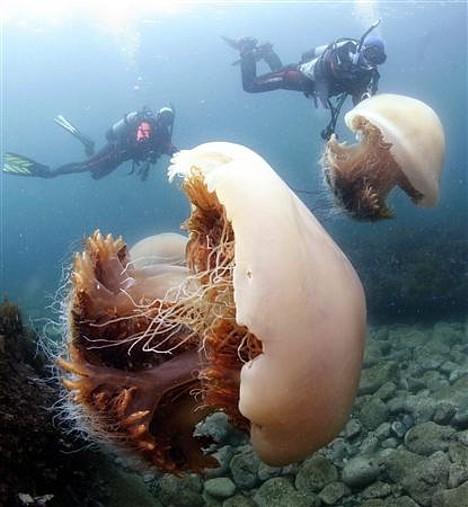
Giant jellyfish like this one are taking over parts of the world's oceans as overfishing and other human activities open windows of opportunity for them to prosper, say researchers.
In this photo, a diver is attaching a sensor to track a monster Echizen jellyfish, which has a body almost 5 feet across, off the coast of northern Japan.
Jellyfish are normally kept in check by fish, which eat small jellyfish and compete for jellyfish food such as zooplankton, researchers said. But, with overfishing, jellyfish numbers are increasing.
These huge creatures can burst through fishing nets, as well as destroy local fisheries with their taste for fish eggs and larvae.
Anthony Richardson of CSIRO Marine & Atmospheric Research and colleagues reported their findings in the journal Trends in Ecology and Evolution to coincide with World Oceans Day.
They say climate change could also cause jellyfish populations to grow. The team believes that for the first time, water conditions could lead to what they call a "jellyfish stable state," in which jellyfish rule the oceans.
The combination of overfishing and high levels of nutrients in the water has been linked to jellyfish blooms. Nitrogen and phosphorous in run-off cause red phytoplankton blooms, which create low-oxygen dead zones where jellyfish survive, but fish can't, researchers said.
"(There is) a jellyfish called Nomura, which is the biggest jellyfish in the world. It can weigh 200 kilograms (440 pounds), as big as a sumo wrestler and is 2 meters (6.5 feet) in diameter," Richardson said.
Richardson said jellyfish numbers are increasing in Southeast Asia, the Black Sea, the Gulf of Mexico and the North Sea.
Link
6.09.2009

Canadians make stem-cell breakthrough

In 'great advance' to research, scientists discover new technique that safely turns skin cells into stem cells, removing risks and complications involved in using the technology
Canadian researchers have discovered a new way to turn skin cells into stem cells with fewer potential risks to patients.
Their work removes major barriers to using stem cells, which have an endless capacity for self-renewal, in new medical therapies for people with spinal cord injuries or diseases such as diabetes or Parkinson's.
“We hope these stem cells will form the basis for treatment of many diseases and conditions that are currently considered incurable,” says Andras Nagy, of Toronto's Mount Sinai Hospital. He is the lead author of a groundbreaking paper published online Sunday by the journal Nature.
Dr. Nagy and his colleagues are the first to reprogram human skin cells to an embryonic state without using a virus, collaborating on the new technique with Keisuke Kaji from the Medical Research Council Centre for Regenerative Medicine at the University of Edinburgh.
Dr. Nagy's team has been working full-out for a year on this novel approach, which builds on a breakthrough reported by Japanese and American researchers in November, 2007.
The Japanese took skin cells from the face of a 36-year-old woman and turned them into cells that look and act like embryonic stem cells. The Americans did the same with skin cells from infant foreskins.
In the developing embryo, stem cells give rise to every type of cell in the body: skin, muscle, bone, heart, liver, kidney, brain and 250 other types of specialized cells. The 2007 advance made headlines because it allowed scientists to sidestep the ethical debate over getting stem cells for medical research from aborted fetuses.
But there were two major problems with the technique.
Both the Japanese and American teams used viruses to insert four genes that are active in stem cells into the genome of the mature skin cells.
Viruses can damage healthy DNA. Some of the genes that orchestrated the transformation back to an embryonic state can also cause cancer.
Dr. Nagy and his colleagues have developed a technique to make stem cells without either of these drawbacks.
Without using a virus, they were able to slip four genes into skin cells that reprogrammed them to an embryonic-like state. They were also able to then get rid of the genes with the potential to cause cancer.
How did they do it? The team used a jumping gene, a mobile piece of DNA also known as a transposon. In moths, corn and other species, these genes hop from chromosome to chromosome, inserting themselves randomly into the genome. They give rise to the kind of genetic variability that can help species adapt to changing conditions.
First, Dr. Nagy and his colleagues inserted the four reprogramming genes into a jumping gene from a moth. Then they put the jumping gene and its cargo into a skin cell.
The jumping gene cut and pasted the stem cell genes into a chromosome in the skin cell. The scientists were then able to coax the skin cell back to its embryonic state, giving it the superhero-like ability to turn into many types of cells.
In many cases, they found that the jumping gene then took a second leap to another chromosome. But 60 per cent of the time, the second cut-and-paste operation wasn't successful. This meant the four genes were not reinserted back into the genome of the skin cell, and disappeared, as did the jumping gene.
“It goes back to the original,” Dr. Nagy said.
The Canadian researchers were able to easily identify the stem cells that were no longer carrying the four genes.
The work is a “great advance,” says the University of Ottawa's Michael Rudnicki, a leading stem cell researcher who is not involved in the study.
“These will be relatively pristine cells that can certainly be exploited therapeutically and will be useful for research purposes,” he said.
Many scientists believe that the flexibility and regenerative power of stem cells hold great promise in the treatment of many diseases, including Alzheimer's, and that one day they may be used to repair damaged hearts, kidneys, livers or other tissue, or even to grow new organs for transplant.
Dr. Nagy's team performed the experiments on both mouse and human cells. They are now using their technique to grow stem cells from the mature cells taken from patients suffering from a variety of diseases, including cystic fibrosis.
One day, the work could allow patients to be treated with their own reprogrammed stem cells. But Dr. Nagy said it is difficult to predict how soon that could happen.
Link
6.08.2009
Vancouver world's most livable city, Harare the worst: Poll

Toronto 3rd, Calgary in 6th spot
Vancouver has once again snagged top honours as the world’s most livable city, while Harare, Zimbabwe, was pronounced the toughest city to live in.
Canadian and Australian cities hold six of the top 10 slots in the Economist Intelligence Unit’s global livability poll, which ranks 140 cities on five factors: health care, stability, culture and environment, education and infrastructure.
“I’m not surprised,” Vancouver Mayor Gregor Robertson said. “There’s often focus on our challenges and negativity, but when you look at the big picture, Vancouver is a remarkable place to live and work and it’s great to be recognized for that.”
The poll listed Vancouver in first place with a rating of 98 per cent, with the report noting the city’s only challenges were “petty crime and availability of good-quality housing.”
Vancouver was followed by Vienna, Melbourne and Toronto in the top four, while Helsinki, Geneva, Zurich and Sydney also placed among the top-10 livable destinations.
The report noted there wasn’t much difference among the top- 10 cities, which tended to be mid-sized, in developed countries with a low population density and with lower crime levels or infrastructure problems often caused by large populations.
London and Manchester, for instance, also placed in the top tier, but weren’t as high, reflecting “the challenges faced by many large urban centres,” the report said.
“London and Manchester both benefit from the attractions that a big city offers but also suffer from the problems that can be faced such as crime, the threat of terrorist attacks and overloaded transport infrastructure,” said the report’s editor Jon Copestake.
Most of the poorest performing locations were in Asia and Africa, “where civil instability and poor infrastructure present significant challenges,” the report said. “The prospect of violence, whether through domestic protests, civil war or the threat of foreign incursion, plays a significant role in the poorest performing cities,” the report said. “They can exacerbate the impact of instability on other key livability categories.”
Robertson said he hopes Vancouver can use its honour to bring more investment and “help us build an even better city.”
Link
Best and Worst Fast Food: McDonald's Edition

No matter how well you plan, every day can't be an ultra-healthy, bring-your-own-lunch-to-work day. But just because you're eating at a fast food place doesn't mean all bets are off. Get to know your options with the healthiest and unhealthiest foods at McDonald's.
To put this post together, we pored over the nutritional fact sheets for all the items at McDonald's. The following list of healthiest and unhealthiest foods was compiled based on several factors, including total calories, fat, and sodium content. It's up to you to decide which dietary trade-offs you're willing to make, because when you indulge in a little fast food, trades-offs are inevitable. Need a lot of protein? You'll be eating a lot of salt and fat too. Trying to avoid high sodium content? Good luck with that; you'll rarely find any truly low sodium items at any fast food restaurant outside of ordering fries with no salt.
Below you'll see our galleries for both the healthiest and unhealthiest items at McDonald's. Click through on each for the full run-down.
Five Healthiest Foods at McDonald's
Five Unhealthiest Foods at McDonald's
The biggest key to eating healthier at a fast food place—which will come as a surprise to no one—is portion control. If you're going to grab McDonald's for lunch, you really need to ask yourself how important getting a huge meal like a Quarter Pounder with Cheese, a large fry, and a chocolate shake is, compared to a more moderate meal like a regular hamburger, a small fry, and a small Coke. The former provides for the entire daily caloric needs of an average size adult, while the former leaves plenty of room for breakfast and dinner.
Blogs Falling in an Empty Forest
Many people start blogs with lofty aspirations — to build an audience and leave their day job, to land a book deal, or simply to share their genius with the world. Getting started is easy, since all it takes to maintain a blog is a little time and inspiration. So why do blogs have a higher failure rate than restaurants?
According to a 2008 survey by Technorati, which runs a search engine for blogs, only 7.4 million out of the 133 million blogs the company tracks had been updated in the past 120 days. That translates to 95 percent of blogs being essentially abandoned, left to lie fallow on the Web, where they become public remnants of a dream — or at least an ambition — unfulfilled.
Judging from conversations with retired bloggers, many of the orphans were cast aside by people who had assumed that once they started blogging, the world would beat a path to their digital door.
Not all fallow blogs die from lack of reader interest. Some bloggers find themselves too busy — what with, say, homework and swim practice, or perhaps even housework and parenting. Others graduate to more immediate formats, like Twitter and Facebook. And a few — gasp — actually decide to reclaim some smidgen of personal privacy.
Richard Jalichandra, chief executive of Technorati, said that at any given time there are 7 million to 10 million active blogs on the Internet, but “it’s probably between 50,000 and 100,000 blogs that are generating most of the page views.” He added, “There’s a joke within the blogging community that most blogs have an audience of one.”
That’s a serious letdown from the hype that greeted blogs when they first became popular. No longer would writers toil in anonymity or suffer the indignities of the publishing industry, we were told.
Many people who think blogging is a fast path to financial independence also find themselves discouraged. Matt Goodman, an advertising executive in Atlanta, had no trouble attracting an audience to his self-explanatory site, Things My Dog Ate, which included tales of his foxhound, Watson, eating remote controls, a wig and a $400 pair of Prada shoes.
“I did some Craigslist postings to advertise it, and I very quickly got an audience of about 50,000 viewers a month,” he said. That led to some small advertising deals, including one with PetSmart and another with a company that made dog-proof cellphone chargers. Mr. Goodman posted a video of his dog failing to destroy one.
“I guess the charger wasn’t very popular,” he said. “I think I made about $20” from readers clicking on the ads. He last updated the site in November.
Mr. Jalichandra of Technorati — a blogger himself — also points out that some retired bloggers have merely found new platforms. “Some of that activity has gone to Facebook and MySpace, and obviously Twitter is a new phenomenon,” he said.
Others simply tire of telling their stories. “Stephanie,” a semi-anonymous 17-year-old with a precocious knowledge of designers and a sharp sense of humor, abandoned her blog, Fashion Robot, about a week before it got a shoutout in the “blog watch” column of The Wall Street Journal last December. Her final post, simply titled “The End,” said she just didn’t feel like blogging any more. She declined an e-mail request for an interview, saying she was no longer interested in publicity.
Link
According to a 2008 survey by Technorati, which runs a search engine for blogs, only 7.4 million out of the 133 million blogs the company tracks had been updated in the past 120 days. That translates to 95 percent of blogs being essentially abandoned, left to lie fallow on the Web, where they become public remnants of a dream — or at least an ambition — unfulfilled.
Judging from conversations with retired bloggers, many of the orphans were cast aside by people who had assumed that once they started blogging, the world would beat a path to their digital door.
Not all fallow blogs die from lack of reader interest. Some bloggers find themselves too busy — what with, say, homework and swim practice, or perhaps even housework and parenting. Others graduate to more immediate formats, like Twitter and Facebook. And a few — gasp — actually decide to reclaim some smidgen of personal privacy.
Richard Jalichandra, chief executive of Technorati, said that at any given time there are 7 million to 10 million active blogs on the Internet, but “it’s probably between 50,000 and 100,000 blogs that are generating most of the page views.” He added, “There’s a joke within the blogging community that most blogs have an audience of one.”
That’s a serious letdown from the hype that greeted blogs when they first became popular. No longer would writers toil in anonymity or suffer the indignities of the publishing industry, we were told.
Many people who think blogging is a fast path to financial independence also find themselves discouraged. Matt Goodman, an advertising executive in Atlanta, had no trouble attracting an audience to his self-explanatory site, Things My Dog Ate, which included tales of his foxhound, Watson, eating remote controls, a wig and a $400 pair of Prada shoes.
“I did some Craigslist postings to advertise it, and I very quickly got an audience of about 50,000 viewers a month,” he said. That led to some small advertising deals, including one with PetSmart and another with a company that made dog-proof cellphone chargers. Mr. Goodman posted a video of his dog failing to destroy one.
“I guess the charger wasn’t very popular,” he said. “I think I made about $20” from readers clicking on the ads. He last updated the site in November.
Mr. Jalichandra of Technorati — a blogger himself — also points out that some retired bloggers have merely found new platforms. “Some of that activity has gone to Facebook and MySpace, and obviously Twitter is a new phenomenon,” he said.
Others simply tire of telling their stories. “Stephanie,” a semi-anonymous 17-year-old with a precocious knowledge of designers and a sharp sense of humor, abandoned her blog, Fashion Robot, about a week before it got a shoutout in the “blog watch” column of The Wall Street Journal last December. Her final post, simply titled “The End,” said she just didn’t feel like blogging any more. She declined an e-mail request for an interview, saying she was no longer interested in publicity.
Link


Mile-High Dogfight: Real Sweat, Fake Weapons

Golf too slow? These weekend warriors roar through the sky searching for the next ''kill.''
Hitman screamed across an azure sky at 5,000 feet in hot pursuit of Mack Attack, pulling some serious Gs as he shot up out of an inverted roll and dive. Although the wings of his Marchetti SF-260 fighter plane started to vibrate and his vision began to blur, he kept pulling the nose of the plane up even as he sunk further into his seat. Hitman didn't want to be killed.
Drenched in sweat, his nervous system in overdrive, Hitman pushed out deep grunts of breath in an attempt to keep oxygen flowing to his brain. Hoping for a clear shot at his prey, he dropped the nose of his plane down, then rose quickly, flipping to the side. Mack Attack mirrored the move, known as a Low Yo-Yo. For 10 minutes, the duo's dogfight resembled an aerial dance.
Then Mack Attack made a mistake, losing sight of Hitman, who maneuvered behind him and pulled his trigger. "When I saw the smoke coming from the back of his plane, it was a really cool feeling," says Hitman, recalling his victory roll.
On the ground, Hitman is Hoyt H. Harper, II, a 53-year-old brand manager for Starwood Resorts, focused on the chain's Sheraton hotels. Ultimately, Harper is responsible for the music you hear in a Sheraton lobby and the size, shape and smell of the soap in each room.
Mack Attack is Peter Mack, a Starwood coworker some 20 years younger than Harper (he refuses to divulge his actual age) who is in charge of Starwood's marketing partnerships. On most days, the two men sit at desks or give Powerpoint presentations in meetings at the company's office in White Plains, N.Y. When it comes to leisure activities, coworkers hit the links for a game of golf or head out to the water for a day of fishing. Not Harper and Mack. These guys prefer to live out their Walter Mitty fantasies by climbing into actual fighter planes and participating in adrenaline-pumped dogfights a mile above the earth.
"It's exhilarating, competitive and physically challenging," says Harper. "Everything about it is exciting."
Mack adds: "You get such a rush from the speed and G-forces, and it doesn't wear off for months afterward."
The purveyor of these fantasies is Air Combat USA, a civilian dogfighting school based in Fullerton, Calif. The company has taken up 40,000 customers since its founding in 1988, operating an aerial circus that travels to 30 mostly smaller and mid-sized airports.
Link
"This. Sounds. So. Freaking. Awesome!!"
Subscribe to:
Posts (Atom)